Where do invoices come from?
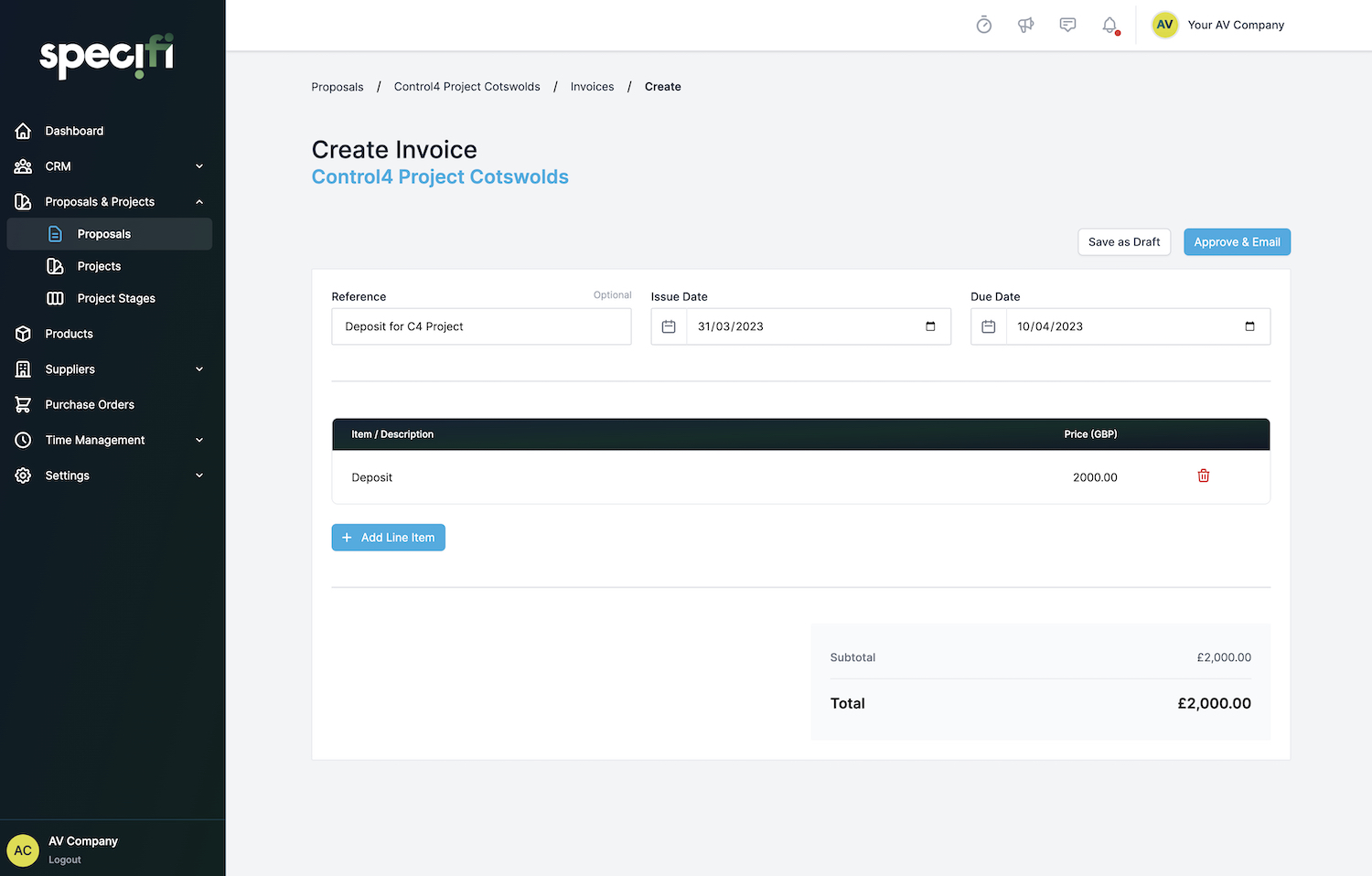
Every invoice in Specifi originates from a project, a work order, or a service call that already lives in the platform. You never retype a line item; the invoice pulls labour, materials, and agreed pricing from the source record. This matters because the cost basis, the tax treatment, and the client billing address are already correct. A milestone invoice on a £120,000 residential integration becomes a button-click, not a 20-minute admin job. Ad-hoc invoices for items outside the project system are supported, but the common flow is project → invoice without intermediate re-entry.
What billing models are supported?
Deposit, milestone, time-and-materials, progress-billing, retainer, and subscription are all first-class. Deposit collection happens at proposal signature via Stripe. Milestones fire on project-phase completion. T&M pulls from approved time entries in the field app. Progress billing works as a percentage-of-complete model for long-running commercial installs. Retainers and subscriptions handle service-contract clients with recurring billing. Each model has its own template; a business with a mix of residential T&M and commercial milestone work uses both without reconfiguring the platform.
How does Stripe integration work?
Stripe is embedded. Every invoice includes a pay-now link to the customer portal; clients pay by card, Apple Pay, Google Pay, or ACH / BACS bank transfer depending on their region. Specifi does not take a cut of the payment. You pay Stripe's standard processing fee directly to Stripe. The platform does not apply a surcharge on top of Stripe's fee, which a small number of competitors in this space do (watch for "payment convenience fees" in their billing). Successful payments reconcile back to the invoice automatically and the invoice status flips to paid.
Does it sync with QuickBooks Online?
Yes, two-way, included on every plan. Invoices generated in Specifi sync to QuickBooks with the right customer record, line items, tax codes, and payment allocation. Payments logged in QuickBooks reconcile back to Specifi. Credits and refunds sync both ways. Sales-tax treatment respects the client's billing address and the per-line tax codes you configured. The integration is live-tested on every release; a broken sync is a P0 for us, not a known-issue we ship around.
Does it sync with Xero?
Yes, two-way, included on every plan. Feature-parity with the QuickBooks integration. Chart-of-accounts mapping, tax-rate mapping, and tracking-category support all configurable in one place during onboarding. Multi-currency Xero organisations are supported, including the common UK-integrator case of a GBP base currency with USD and EUR client billing. If you currently run Xero with a bolted-on CSV export from your quoting tool, the Specifi → Xero path retires the CSV step and kills a recurring data-entry error.
What about Sage?
Sage is on the product roadmap, not live today. We will not claim it is. If Sage is a dealbreaker, ask us about the timeline on the demo before you commit and we will be straight with you. The current recommendation for Sage-based integrators is to run the CSV-export bridge through the early months of onboarding and migrate to the native sync the moment it ships. We migrate you at no charge when the native sync arrives.
Can I surcharge a card fee to the client?
Where local law allows it, yes. The invoice template supports a configurable surcharge line that applies to card payments only; bank-transfer payments sidestep it. The surcharge displays transparently on the invoice so the client can choose the payment method. Specifi does not apply a platform surcharge of our own on top; the only card fee the client sees is the pass-through of Stripe's processing fee where you have chosen to pass it on. Some jurisdictions (including parts of the EU and Australia) restrict or ban card surcharging; the invoice engine respects those restrictions per-region.
Can clients pay a single invoice across multiple payment runs?
Yes. Partial payments are supported on every invoice. The client can pay a fraction by card and the balance by bank transfer, or split across two card runs, or pay in instalments over a negotiated schedule. Each partial payment reconciles back to the invoice and the accounting integration; the invoice balance updates in real time. Overdue balances surface on the dashboard and trigger configurable reminder emails. You control cadence and tone of the reminders; the platform does not default to chasing a client at three-day intervals unless you tell it to.
Is there a limit on invoice count or value?
No. Invoicing is unmetered on every plan. A 12-invoice-a-year residential specialist and a 4,000-invoice-a-year commercial integrator pay the same Specifi subscription for the same invoicing feature set. No per-invoice fee, no per-pound billed fee, no "enterprise invoicing" upgrade tier.
What about taxes — VAT, sales tax, reverse charge?
Standard-rate, zero-rate, reverse-charge, and per-line tax overrides are all supported. Tax codes configured during onboarding map to your accounting package's codes so the sync stays clean. US sales tax respects the ship-to / service-location per US state; EU VAT respects place-of-supply rules including reverse charge for B2B cross-border supplies. If your business operates across currencies and jurisdictions, our onboarding team configures the tax codes with your accountant rather than guessing; this tends to save a painful mid-year re-statement later.
Can clients see and download old invoices?
Yes. The client portal shows every invoice ever issued against their account, open and closed, with pay-now buttons on anything still outstanding and downloadable PDFs on anything closed. Clients can reconcile their own records without phoning your office for a copy. Portal access is free on every plan and scales to as many client logins as you need.
What happens if a payment fails?
A failed card payment triggers a retry schedule (configurable, default 24 hours / 3 days / 7 days), a portal notification to the client, and an office alert to your account manager. The invoice does not silently sit in arrears. Failed-payment reasons (expired card, insufficient funds, bank decline) surface in clear language so you can have the right conversation with the client. For bank transfers that bounce back or get rejected, the platform flags the reversal and prompts you to re-issue.